Showing posts with label writing. Show all posts

Tuesday, 26 November 2024

26/11/24 PLD Refreshed Curriculum, 3

In this session, we applied our analysis process to the Writing part of the English Curriculum (leaving aside Handwriting, which we have already tackled separately).

Our current programme is outlined at the top of the sheets, while the new Curriculum requirements are added below.


Key observations:

  • Writing quantity: we talked a lot about how the year 1 curriculum now stipulates only one or two sentences, but is very clear about the quality of the transcription and spelling skills being taught. We speculated that, currently, we may rush children on to writing too much before transcription skills are embedded.
  • The years 4 - 5 curriculum has progressively less about transcription and more about text types, content, language, audience etc. We discussed cognitive load: ideally, if children are proficient transcribers by year 4, they have more capacity to develop their content, structure and style.
  • We noted that the transition from the old to new curriculum may leave more students than usual needing teaching to support their transcription skills so that they can access the year 4-6 content. Writing passports should help to pinpoint what our students need from day 1, but we may also need to capture now who is going to need what add/sup support.
  • We noted that, while we're already teaching a lot of the content here, we need to be very clear about expectations at each year group and making sure in a blended class that we are attending to the skills progressions needed.
  • Handwriting: do we have a unified stance? Is the NZ Handwriting Challenge the way forward.
  • There is a lot to fit in here, needed a careful analysis of how we are going to use our time and how we can save time (e.g. quicker transitions).







Thursday, 23 February 2023

Writing PLD 1: effective use of writing models

Our writing PLD cycle begins at text level. We know the value of good writing models to demonstrate text types and structures, purpose and voice, vocabulary and punctuation use. Writing models can also provide our students with a way into writing with sentence starters or accessible structures. We can also use text models to explore the choices that writers make and how we might edit and improve our own writing. Models might be published texts or created by our students.

For this session, we each shared at least four models, chosen with our students in mind: how will this writing model advance my students' understanding of texts and give opportunities to improve their writing skills? We tried to think at text, sentence and word level.

Sharing our models in small groups, we explored the uses we could put them to in the classroom.

We also drew some general conclusions based on our discussions.

This is saved here, in this slideshow.

Saturday, 18 February 2023

Setting the scene for our 2023 Writing PLD, 1st Feb. 2023

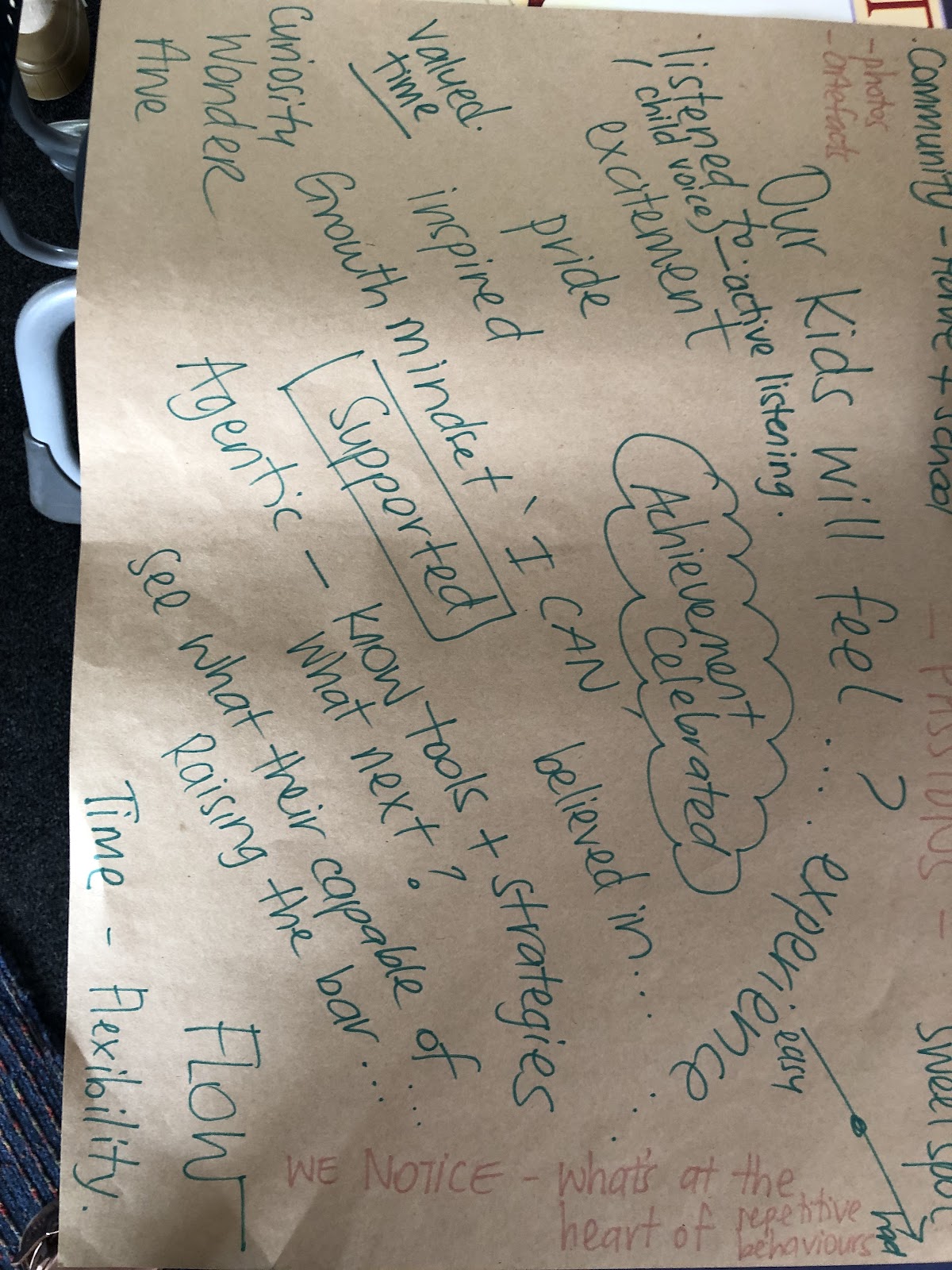
 1. A joyful literary culture.

In her book 'I've Got Something to Say', Gail Loane discusses fostering a joyful literary culture in our classrooms (and in our wider lives).

What does a joyful literary culture look like in our classrooms? What will we see, hear, feel?

Activity: 

(i) Write ideas on postits

(ii) Sorting components: physical environment vs. human (pedagogy, teacher actions).


2. We shared our personal experiences of an inspiring creative atmosphere. What are the implications for us in our classrooms?

3. John Hattie: what does it mean to be a successful teacher?

It's what we do from moment to moment in our classrooms that makes a difference.


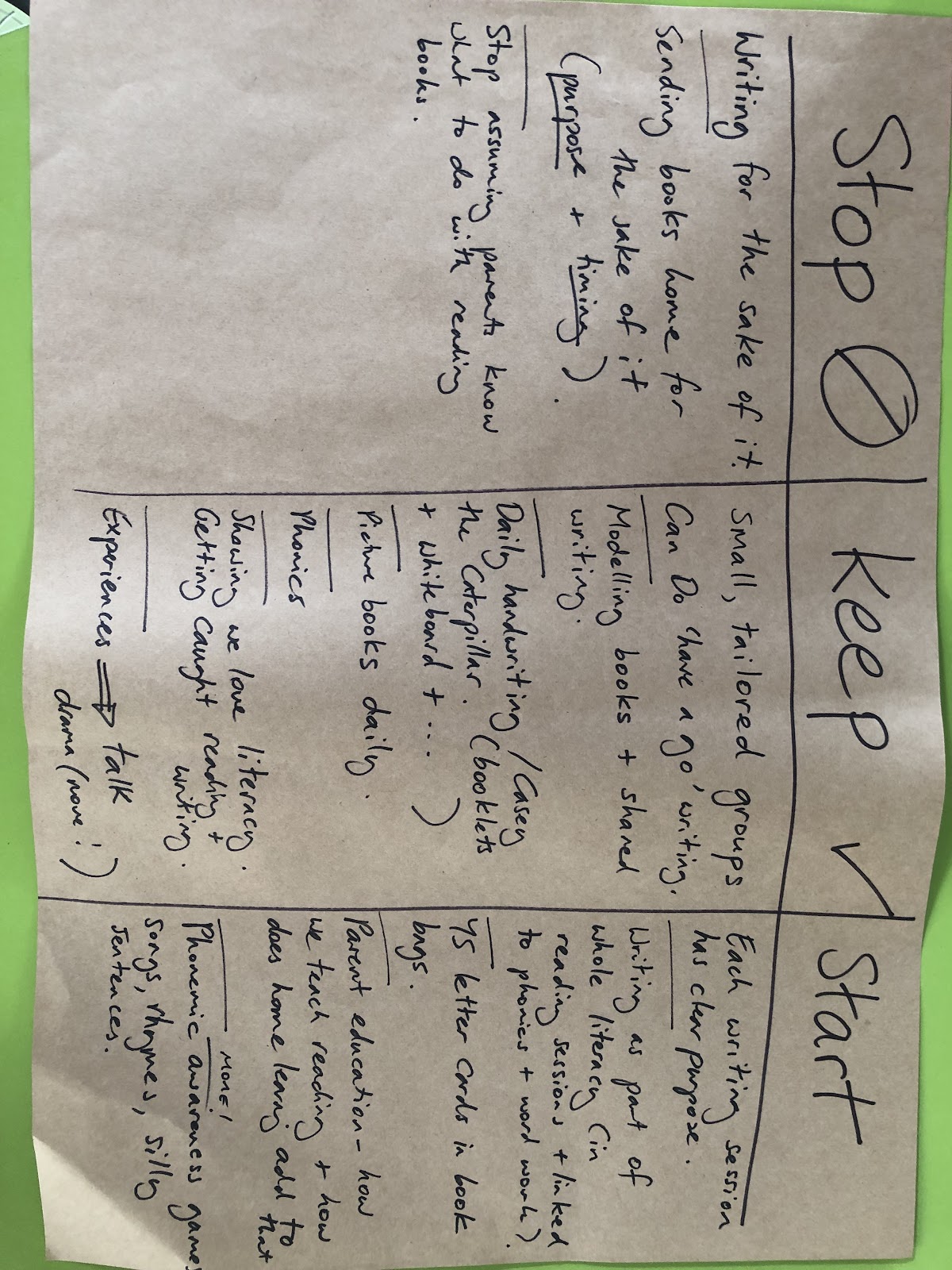
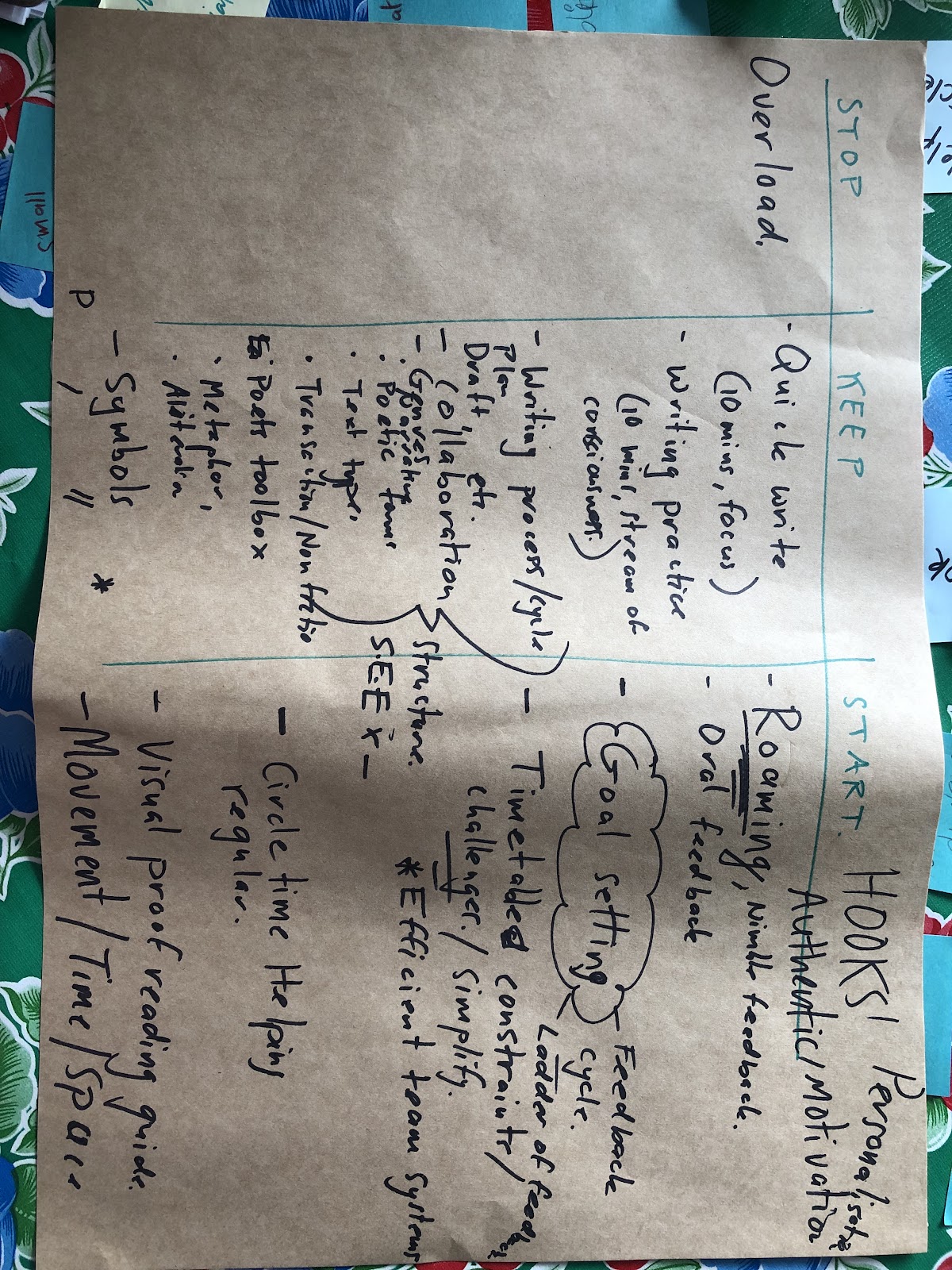
4. Fostering a joyful literacy culture in our classrooms: what teacher actions can we take?


Stop, keep, start and further blue sky thinking for our own spaces.


5. PLD overview: what's to come?


Tuesday, 18 September 2018

Writing Moderation

We looked at 4 writing samples and had in depth discussion about writing levels. We came back to the Writing Matrix


Wednesday, 4 July 2018

Reflection from Teacher Inquiries

We shared our TAIs with each other in small teams.

A summary of TAIs with links to individual TAIs.

Here are our next steps:

Matariki/ Mahutonga Actions:

Effective Feedback has helped to raise achievement for students in Mahutonga Matariki.
Effective interventions from our TAI which we will implement in the programme include:
Written Feedback is given as a question, with the intention of action being taken. (Can you…..?) No more than 2 actions
Responding to feedback timetabled
Focus on typed feedback
Keeping a feedback folder to track goals
Pink and green coding used (artfully) in a range of ways
PSG in margins, making students work
Feedback given to the writer, not to the piece of writing.
Feedback connects to student’s goals and writing criteria

Autahi Actions:

Keep it simple
Connecting reading and writing for emergent writers
Using Yolanda Soryl type phonics/formation teaching (letter formation is connected to sound/letter knowledge)
Using visual success criteria, experience and writing exemplars for those that need pushing to the next level
Making writing fun and different (with art, etc).

Tautoru Actions:

Suz- sound boxes using frequency words to fluency. Linking from reading to writing.
Keeping writing relevant to current experiences in other curriculum areas to expand vocabulary and give authentic reasons to write.
Find regular opportunities to share with an audience.
Giving feedback on specific goals/SC (some of ours can’t read the feedback so will need to think about how to record). For more fluent writers:Using P-punctuation and S-spelling. Use pink and green.

Monday, 28 May 2018

Audience, Purpose and Motivation for Writing

Prior to the session we read:
Alison Davis, Effective Writing
Chapter 8, Celebrating and responding to writing

The key ideas: 
  • Having a clear purpose and audience for writing is highly motivating for students, and involving them in determining this is an effective way to build motivation. 
  • Students can learn a lot about writing through investigating their own and other's writing.
  • Maintenance of skills and strategies for writing is an important aspect of everyday class practice.
  • Allowing students a choice in writing activities provides an incentive for involvement and an interest in writing. 
  • There are a wide range of possibilities in the creation and celebration of writing. 
We used the ECG template to discuss the reading in groups. 

Senior Team 

Junior Team:

We asked why write? 


We used Coggle to make a list of our students and attach them to an audience that might work for them.

Tuesday, 22 May 2018

Exploring Active Demonstrating- Inspired by Murray Gadd

Breathing exercise by Gabrielle from the Focus 5 resources

We started off by John telling a story. He asked what we need to include in our writing e.g. punctuation, hooking reader in etc. "What are best words? Make a note of those… Let’s start writing."

Shared Writing- led by John

Shared writing led by Anna


Shared writing led by Carl

We set goals with a focus on active demonstrating. We will check in on these in two weeks. Active Demonstrating Goals

Triples is coming up in next week. We will be following the same format as last time. 

RECAP:
Purpose of Triples :
  • Raise the writing achievement for all students.
  • Share and critically reflect on our teaching of writing - identifying areas of strength and areas of improvement.
  • Reflect, support, challenge, question, feedback, analyse, learn from each other.
  • Leave the Triples session with clear actions to implement and improve student outcomes.    We will be coming back to these.

This TIME
Your lesson for observation will be with the same group that you taught the last time. 
It is also another opportunity to add feedback and progression to your Teaching as Inquiry. We are trying to align our TAI, PPG etc 
If your TAI is focused on improving feedback -  it would be good to see how feedback is being given and used by your group.       

Sunday, 20 May 2018

Teacher Inquiry Check In: Thursday 17th May


We started the session with a Kahoot quiz about Formative Assessment. If you missed the session or would like to take the quiz again, you can Click Here.

We discussed where we are at with our Teacher Inquiries in small groups. We all shared our next steps. 

We will be celebrating our inquiries in Week 9. We are all learning from each other!


Formative Assessment: Writing Focus, Monday 14th May 2018

Ximena started with a breathing exercise

General discussion in teams: What would a classroom in which formative assessment and feedback are happening look like sound like etc?  

The Key Messages from Dylan Wiliam:


1. Everybody is thinking all the time.
2. Make students do the work.
3. Only give give feedback that will be used.

What could these statements look like in action?

Seniors:


Juniors: 


Examples of feedback:  We shared a piece of writing and discussed different approaches to written feedback. We evaluated in pairs.


There is some consistency around pink and green. Teachers are generally picking out one thing to work on and one thing that is going well. Feedback is usually linked to a student's goal. The juniors are using symbols. We agreed that we write words above the words.


Seniors: P for punctuation, G for grammar, S for spelling. Simple marking.


Here are examples of exit tickets in Maths:


What could this look like in writing at your kid’s level?
During discussion we thought that exit tickets could be good if the questions were open e.g. Can you write a simile? Multi-choice might work well too. ARBs- short tasks would work well. We could collect a bank of exit tickets for skills. You could ask students things like how would you shape a green light question? Using exit tickets could be good for workshop planning.

Further Reading:


These are Ximena's notes from Dylan Wiliam course, Embedding formative assessment with teacher learning communities:

Sunday, 1 April 2018

Feedback- What is Happening? March 28th

We are really keen to dig down and explore what people are doing with regards to feedback currently. We want to explore what our current ideas are and our burning questions.

As with a PMI - We asked teachers to contribute thoughts, ideas and questions to the slides with initials. This will be the basis for our future discussions.

Wednesday, 28 March 2018

Writing- 22nd March

Today we discussed something new that we have tried in writing this week. Here are some examples:

Susie-


Nicola: 


Ximena:

Thursday, 15 March 2018

Writing Session 7- Proof Reading V Editing

Nicola's Notes from Alison Davis: Effective Writing- Section on editing and proof reading

Success Criteria? WALT? Learning Questions? How do kids know what they are learning?
We split into two teams

1.
Gillian
Shona
John
Gabrielle

2.
Suz
Scott
Ximena
Anna
Nicola

Notes from session:

Gillian: Visual editing card co-constructed
Developing by focusing on one element at a time (eg. finger spaces)
Some students, as they become more able can deal with more.
Has begun using some visual cues related to genres.

Shona: Using SC on the board at the start of lessons. Some focus on surface features, Capitals and full stops
What we used last year - similar set for a while
writing tasks are kept tight
Feeding forward before they write - setting a goal along the way comments in the book
editing visuals
editing card visuals


Anna is using - checklists
tools that kids can use as their own success criteria
editing checklists
green light orange light - focusing on just this
“He is my buddy when I don’t have one”
Questioning - learner attributes - making links to LA through writing
Editing card for HFW
Editing is ‘Being a Thinker’ by………..
IYT Coaching - You are being a thinker -
Helping Circle - need to be more explicit
What did we do today to make our writing better?
Matrices - which ones do kids understand?

How could we re-word - more concrete ?
Can we see a Progressions of editing/sc/tools across the school.
Are we proof reading or editing ? or both ? 
Editing as they write - Gail Loane

Scott is using:


Seniors are using: Poem Success Criteria

Goal setting folder: Goal Setting

For next week. Try something new. Bring along photos and share what has worked/ has not worked. 

Something to think about...

Monday, 12 March 2018

Writing- Session 6

We got into our Jigsaw groups and shared what we have learnt from our readings. We did presentations to our group.

Suz, Scott- Alison Davis- Chapter 4, Different writing instruction

Alison Davis- Chapter 4, Different writing instruction

Nic, Gabrielle- Jo Boaler/ Growth Mindset and Assessment


John, Gillian - What do writers say good writing?


Ximena, Anna  - Effective writing (Murray Gadd)


Shona, Susie - Teachers as readers and writers (apologies)

Tuesday, 6 March 2018

Writing- Session 5 (Planning for Triples)

Minutes by Ximena

Present: Jude, Suzanne, Shona, Anna, Ximena, Susie, Nic, Gillian, Gabrielle
Apologies: John and Scott.

Triples planner: The work will be for ongoing sessions.
You will need to complete planner (see doc)
This might link to your TAI but other things may pop up.

Discoveries:
Anna- Triples as a Kaizen step to TAI. (Both can be used as evidence for PPG).
Gillian- Good to have this time to chat, ask questions and clarify how triples, TAI and PPG all fits together. Also good to share context of TAI so others in the group get a clearer picture of the aims.

Action:
Have lesson planner ready before observations next week.

Writing- Session 4 (The Hunches)

Minutes by Nicola

Scott: I am sharing writing from an EEL . I am really impressed with this writing. I like how he did not follow the structure. He has shown imagery and is in the scene. He is gaining lots of vocab. He is orally ready.


Anna: I am sharing a child’s writing. We read Rata and the tree and took on different character from the story. He has taken on board feedback from mum on Seesaw. The editing that he has done is punctuation and has taken out one word. You can see personal voice from the forest people. Philosophy and ideas are strong. He has the purpose and audience.


The Writing Hunches

Anything you think is not relevant or anything to add?

Maybe our students already have an audience. They share with each other. There is Seesaw and there is us I think it is better when there is an audience. Looking out for more opportunities. The Minecraft video is a good example. There are different levels of audience and purpose. Feedback from parents is always rosy. What are we saying? Peer buddies give accountability. Everyone is heard.

Parent engagement in writing is difficult. Looking through a feedback lens- how much do parents know? What kind of feedback is given? Getting parents involved is light at the moment.

Sometimes teachers/ students need to say why they are posting or add articles.

Assemblies are a good time to share and use opportunities to say why we are doing what we are doing.

The purpose/ audience needs to motivate writers. Sometimes writing can be flat and meaningless.

How do we differentiate cognitive load for the different writers in our group? How do we extend the willing writers? How do we value the oral language? How much is linked to oral language? Anticipate the planning process…

One thing at a time…

Making it small and visual and manageable. They need to do one thing at a time. There is a lot of modelling and thinking aloud.

Make a community link. Writing would be more purposeful if it is seen at home.

Session 3- Writing (Teacher Inquiries)

Minutes by Shona

WWW in writing so far this year.

All the Y5 and 6 have taken off from where they left off last year.
When my writers are given enough time, they are editing more- underlining words.
Purpose of a plan.
Results of our survey- children helping each other to complete survey- more relaxed getting feedback with peer support. Cool linking bet reading and writing
Discussed “What a good writer does”- didn’t give up.
Playing with words.
Simplifying the criteria.
Fun seeing what kids do write.
Letter formation on whiteboard every morning- helps with flow and ease of mechanics
Creative writing- originality
Goal setting meetings- kids know next steps
Megan sharing writing after goal setting was great- knew why she was sharing her writing.
Conversation around purpose and audience at goal setting meetings very useful.

Targets from last year.
Look at in own time.
Page 7 Data and disparity info. New targets (in blue) now that Nat Stds gone- “acceleration”- tightening up targets. The ones we are monitoring are girls not meeting expectations, maori not meeting expectations, boys not meeting expectations. All names will be included and a small target group will be identified. Use 2017 data for baseline data. To be completed “together”.

Individual TAI- look at writers in group and see what they are already doing, to determine own TAI. Plan for next week’s writing- who needs a stretch? who isn’t where we thought they were? Think about a shorter TAI- eg termly. ERO recommendation. How much alignment might there be between TAIs with teachers? Could pass TAI on to another group if appropriate.

Purpose of today_ get info ready to share with teams- what are needs of specific kids- eg. how goal setting at beginning of sessions affects writing.

Teams for TAI discussions.

Writing Inquiry template from Nic- make a copy for own inquiry.

Identify focus- done today.

Create own TAI and aim to complete by mid term 2 therefore 3 TAIs in a year completing each mid term (2, 3 and 4). Is this making a difference or not? If not, then change.

Aim for the “LIfting it up”- sharing mid term.

Think about “Hunches” for Thursday. Do you agree?


Questions we want to Inquire into:

1.Do our students know have an audience to write to/for?  
  Are they clear about the purpose for writing?
  Do we plan for ‘audience’?  

2.How do our attitudes towards writing influence our students?
  How would developing the literary culture amongst staff affect         achievement?

3. How can knowledge of themselves as learners (learning to learn)    impact on writing achievement?
  How can we develop student agency in writing?
  What is the impact of having clear writing goals and regular reflection?
  How many goals at a time?
  What is the impact of feedback on development of writers?
  How can students develop their critical eye as writers?
  
4. How do we extend willing writers?